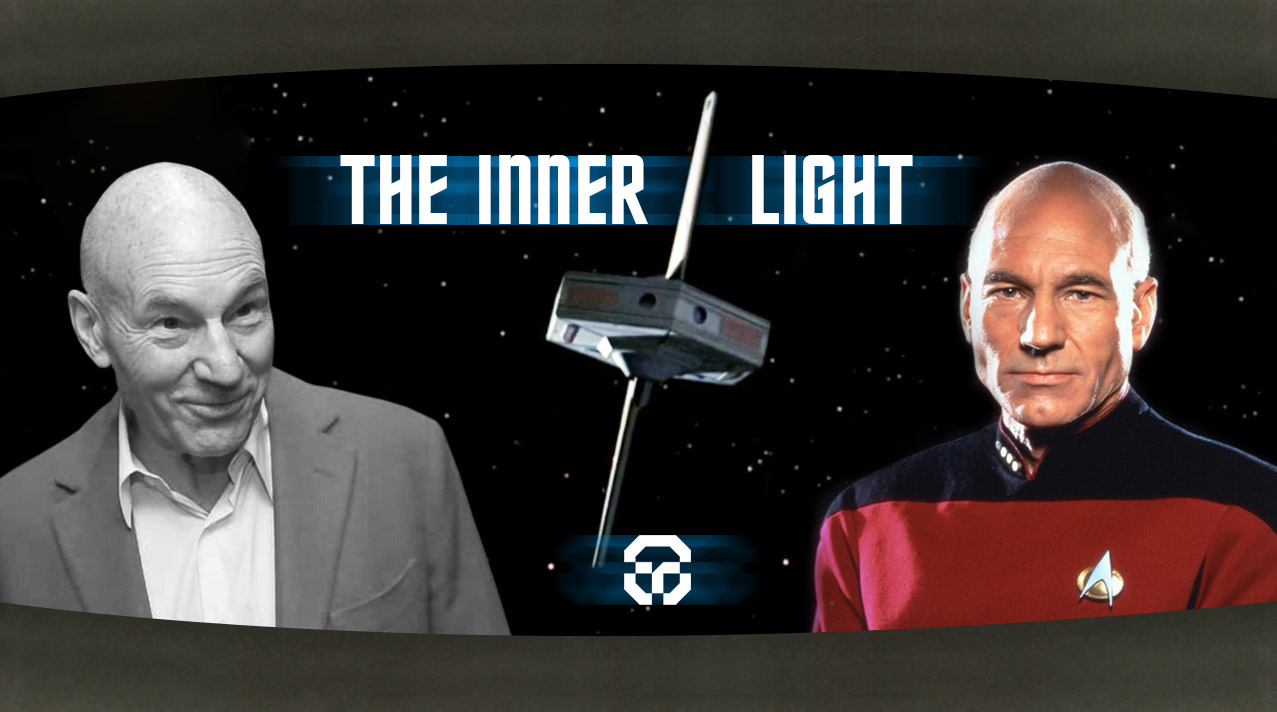
On October 28, 2026, the world said goodbye to Sir Patrick Stewart, the legendary British actor whose voice and presence became inseparable from one of science fiction's most iconic characters: Captain Jean-Luc Picard of the Starship Enterprise. The visionary Jean-Luc Picard, who brought humanity, scientific curiosity and the exploration of tomorrow to millions.
Born in 1940, Patrick Stewart belonged to a generation that grew up with science fiction imagining the future through cinema. Movies such as Dr. Cyclops (1940), The Invisible Man Returns (1940), Destination Moon (1950) and Rocketship X-M (1950) explored the possibilities of scientific discovery, space travel and humanity's place in the Universe.
Long before Star Wars arrived in 1977, these films were already planting the seeds of tomorrow.
Stewart lived through that extraordinary transformation — from the era of early science-fiction cinema to the futuristic world of Star Trek: The Next Generation, where he would become the face of a future civilization exploring distant galaxies.
When Patrick Stewart first appeared as Captain Jean-Luc Picard in 1987, he brought something distinctive to science fiction: a captain whose greatest strength was not physical power, but knowledge, diplomacy, curiosity and moral courage.
Under his command, the Enterprise spaceship explored strange new worlds, encountered unfamiliar civilizations, investigated scientific mysteries and confronted questions about humanity's future.
Picard's adventures often went beyond space exploration. They explored time itself.
Picard and his crew discovered evidence that Data has traveled to 19th-century San Francisco. Picard reflected on fate and the possibility of changing history (“Time's Arrow” — S5, E26, and S6, E01).
When a mysterious visitor claimed to be a historian from the future, Picard confronted the ethical consequences of changing events and interfering with history. He declared: “Every choice we make allows us to manipulate the future!” (“A Matter of Time” — S5, E09)
In the series finale, Picard experienced three different time periods and faced a cosmic mystery that threatens humanity's existence. Q challenges him to think beyond what he knows and consider possibilities he had never imagined. (“All Good Things...” — S7, E25–26).
Back in Season 5, Episode 25: “The Inner Light”(premiered on June 1, 1992 for broadcast tv), Picard experienced an entire lifetime on an unfamiliar planet through an alien probe. The civilization's final act is to send its knowledge and memories into the future, hoping someone will remember them.
That last story is especially meaningful today.
The people of Kataan could not save their civilization, but they could preserve its knowledge, its culture and its memory. Picard becomes the living recipient of their message — a bridge between the past and the future.
Star Trek did more than entertain. It brought scientific concepts and questions about space to a giant global audience. Through the Enterprise's missions, viewers encountered ideas involving:
- Space exploration and distant galaxies
- Artificial intelligence and intelligent machines
- Communication across vast distances
- Robotics and advanced computing
- The nature of time and space
- The ethical responsibilities of scientific discovery
The series made scientific curiosity part of popular culture. It inspired generations of viewers to imagine careers in science, engineering, astronomy and technology. Many of its imagined technologies — from handheld communicators to voice-controlled computers — became familiar reference points as real technology developed. Of course, science fiction does not predict the future with certainty. Its greatest achievement is often to help people imagine what might be possible and ask what kind of future they want to build. Captain Picard represented that vision: a future where humanity had moved beyond many of its divisions and could devote itself to exploration, learning and cooperation.
The team behind the Time Capsule project shares that same spirit of exploration. Inspired by Star Trek and Captain Picard, the we see the future not simply as something approaching us, but as something we can actively explore, prepare for and help shape.
Picard explored space and the Universe.
In a different way, the Time Capsule team explores the upcoming future — considering what humanity will need to know, what knowledge will remain valuable and what discoveries deserve to be carried forward. The connection is especially powerful because Star Trek repeatedly reminds us that the future is built upon the knowledge and achievements of the past.
A time capsule becomes a message across generations.
It allows today's society to communicate with people who may live decades, centuries or even millennia from now. It asks us to consider: What information would we want future civilizations to discover about us? What achievements should they remember? What knowledge could help them avoid repeating our mistakes?
The themes of preservation, discovery and communicating across time are deeply connected to the stories Patrick Stewart helped bring to life in Star Trek.
A Legacy Beyond the Stars
Patrick Stewart's legacy is much greater than a single character or television series. Through Captain Jean-Luc Picard, he helped make science fiction a space for discussing science, ethics, humanity and the future. He showed audiences that exploring the Universe also means exploring ourselves. And perhaps this is the most important lesson for the Time Capsule team.
The information, discoveries and achievements that have developed our world must not disappear with the passage of time. They must be protected, preserved and made available for future generations.
The knowledge that shaped our civilization — scientific discoveries, technological innovations, cultural achievements and lessons from history — deserves to be safeguarded. Like the people of Kataan in The Inner Light, we have the opportunity to send a message forward.
A time capsule is not simply a container of objects. It is a promise that the knowledge of today will not be lost tomorrow.
The Time Capsule team continues that journey in its own way — exploring the future and helping ensure that the discoveries and achievements of humanity remain available to those who will come after us.
Because the future is not only something we travel toward. It is something we leave behind for others
to discover.
“Seize the time. Live now. Make now always the most precious time. Now will never come again.”
— Captain Jean-Luc Picard, Star Trek: The Next Generation (“The Inner Light” — S5, E25).